

Event Data Exports
Configure hourly JSONL data exports of event data to AWS S3 or Google Cloud Storage
Neon provides a number of user behavior insights directly in the Console. You can also set up exports of additional analytics events for more detailed tracking. You can configure these exports via the Console.
We deliver hourly analytics events directly to your AWS S3 or Google Cloud Storage bucket in JSONL GZ format. Events are separated by environment (e.g. Sandbox, Production, Staging), ensuring accurate tracking and analysis (sample file).
This document serves as a comprehensive guide to the analytics events and their associated attributes used within our application. These events play a vital role in tracking user interactions, behaviors, and other essential metrics, enabling you to enhance the user experience and make informed, data-driven decisions.
Configuration
AWS S3
- Set the following bucket policy on your S3 bucket.
Be sure to replace
BUCKET_NAMEin the policy below with your actual bucket name.
{
    "Version": "2012-10-17",
    "Statement": [
        {
            "Effect": "Allow",
            "Principal": {
                "AWS": "arn:aws:iam::171666793654:role/NeonS3Access"
            },
            "Action": [
                "s3:AbortMultipartUpload",
                "s3:DeleteObject",
                "s3:GetObject",
                "s3:ListBucket",
                "s3:GetBucketLocation",
                "s3:PutObject"
            ],
            "Resource": [
                "arn:aws:s3:::BUCKET_NAME",
                "arn:aws:s3:::BUCKET_NAME/*"
            ]
        }
    ]
}-
Open Neon Console, and Navigate to Developer Settongs ->Analytics Exports
-
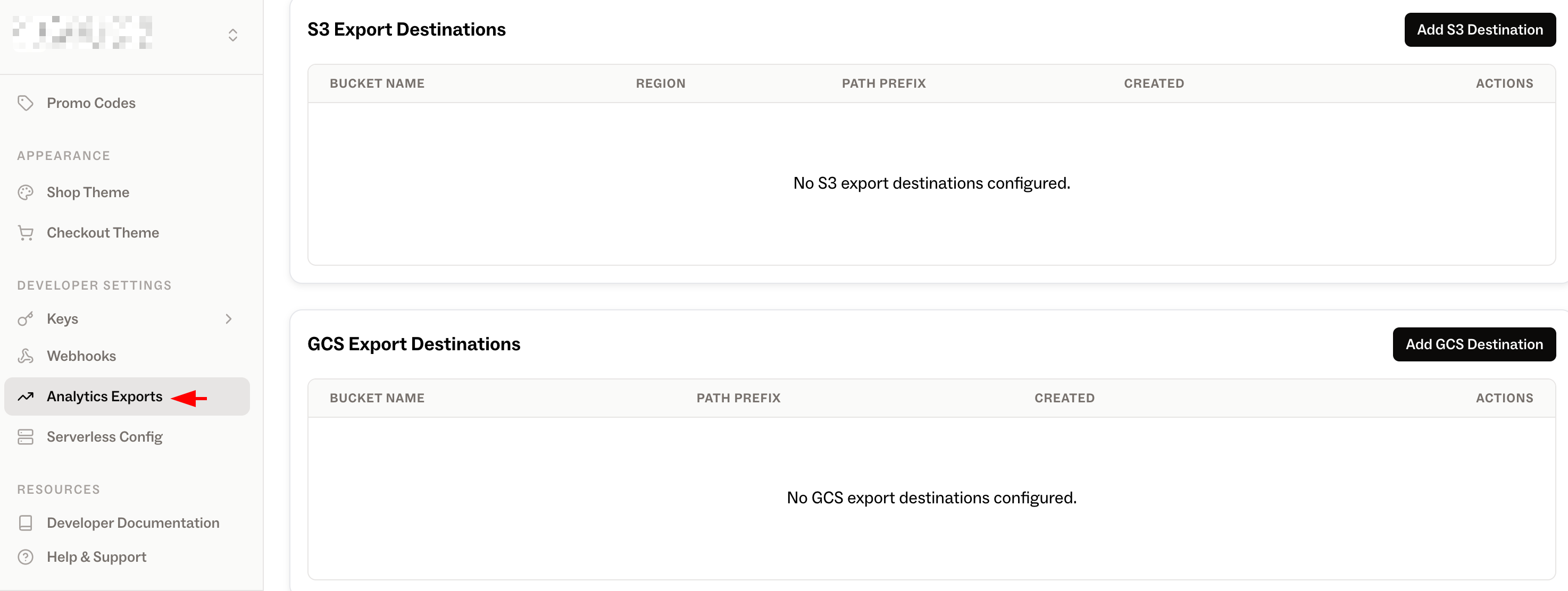
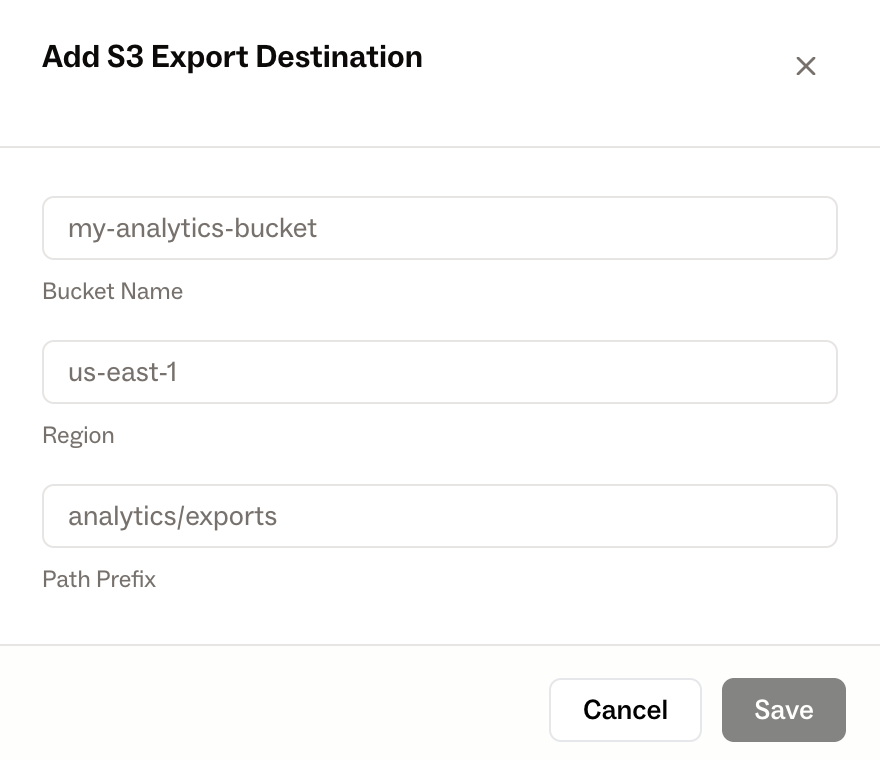
Click “Add S3 Destination” and enter the Bucket Name, Region, and Path Prefix. The Path Prefix defines the folder where analytics exports will be stored. We recommend using a unique prefix per title to keep analytics data organized across multiple titles.
Google Cloud Storage
-
Create a new service account to give Neon access to upload to your Bucket.
-
Create a JSON key for the service account. The key will need to be exported as JSON and securely uploaded to Neon. The key is stored encrypted at rest and will only be accessed for analytics exports.
-
Configure the bucket to grant the
Storage Object Adminrole to the new service account. -
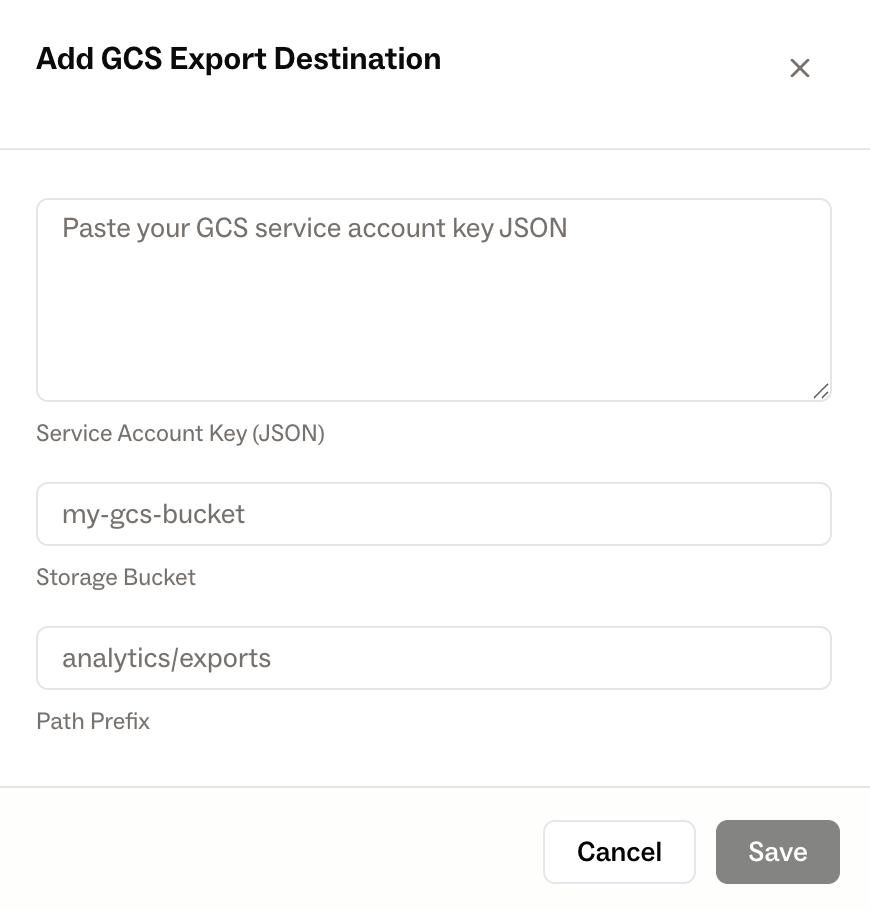
Configure the export with Neon. You'll need to provide the following.
- JSON account key from step 2
- Bucket name
- Prefix (optional)
-
Open the Neon Console and navigate to Developer Settings -> Analytics Exports. Click “Add GCS Destination”, then enter the information obtained in Step 4.
Exported Files
A single gzipped JSON Lines file will be exported hourly to your bucket.
The file will be written to the following path: ${prefix}/${environment_id}/YYYY/MM/DDTHH-neon-analytics.json.gz.
prefix: your optional prefixenvironment_id: Neon provided identifier for game + environment (e.g. Game 1 Production)YYYY/MM/DDTHH: date and hour (in UTC)
Event Details
Analytics events are systematically logged across our application to capture diverse player actions and behaviors. Each event provides invaluable insights into how players engage with your Neon Shop and navigate through the purchasing process. Each event object in the file will include the following top-level keys.
Event Data
event_time: Timestamp indicating when the event occurred.event_type: Type of event triggered, providing context for the player action or behavior.event_properties: Various event-specific attributes. The possible values are specified below.log_version_id: Internal version identifier used to track changes in event logging schema.
Player/Session Data
Events include device and session information when available. However, this data may be unavailable or contain special server values when:
- Users are blocking tracking
- Events are server-initiated (e.g., checkout created via POST /checkout endpoint)
Device & Session Properties
device_id: Device identifier. Returns00000000-c57a-4f9b-afe8-3fe404dc84f5when real device info is unavailable.session_id: Unique session identifier (integer). Returns-1when no session is available.
Browser Information: (Parsed from user agent, null when unavailable)
null when unavailable)os_name: Operating system name (e.g., "Apple iPhone")browser_family: Browser type (e.g., "Safari")browser_major_version: Browser major version (e.g., "16.3")
Geographic Data: (Inferred from IP address, null when unavailable)
null when unavailable)geo_city: City (e.g., "Ottawa")geo_region: State/province/region (e.g., "Kansas")geo_country: Country (e.g., "United States")
Network Information:
ip: Public IP address. Returnsnullwhen unavailable.
Frontend events can be potentially blocked by Ad-blockers
Event Type and Property Definition
Checkout Events
All checkout events will have the following properties: environment_id, checkout_id, player_id, and player_country. They will also have the following nullable fields: storefront_id, metadata, external_reference_id.
Any extra properties in addition to the standard set will be listed below.
| Event Types | Event Description | Source | Extra Properties |
|---|---|---|---|
| Checkout Created | Triggered when a checkout is created. | Backend | offer_skus |
| Payment Method Selected | Triggered when a payment method is selected. | Frontend | payment_method |
| Place Order Button Clicked | Triggered when the player clicks on the "Place Order" button in checkout. | Frontend | |
| Checkout Completion Attempted | Triggered by the backend when a player attempts to complete a checkout. | Backend | |
| Checkout Completed | Triggered when a checkout has been successfully completed. | Backend | offer_skus purchase_id marketing_email_consent(optional) |
| Checkout Payment Failed | Triggered when a payment failure occurs during checkout. | Backend | payment_method(optional) |
| Checkout Back Clicked | Triggered when the player clicks on the back icon on the checkout page. This is not triggered when the player clicks the back button in their browser. The Neon back button only appears when there is a store URL to redirect the player back to. | Frontend | |
| Purchase Completed Modal Displayed | Triggered when the player sees the purchase complete modal with order information. | Frontend | purchase_id |
| Continue Shopping Button Clicked | Triggered when the player clicks on "continue shopping" in the purchase complete modal to close the modal and redirect to the Neon Shop. | Frontend | purchase_id |
| Continue Game Button Clicked | Triggered when the player clicks on "Go to the Game " in the purchase complete modal to close the modal and redirect to the game. Only applicable to mobile phones. | Frontend | purchase_id |
| Refund Processed | Triggered when a refund is processed for a player. | Backend | purchase_id refund_id |
| Saved Payment Method Added | Triggered when a new payment method is successfully added. | Backend | payment_method is_first_payment_method total_saved_cards total_saved_payment_methods is_default |
| Card Payment Method Deleted | Triggered when the player deletes their card as saved a payment method. | Backend | payment_method total_saved_cards total_saved_payment_methods |
| Save Payment Method Toggled | Triggered when the player checks or unchecks the "Save payment method" checkbox toggle during checkout. | Frontend | is_saved_checkbox |
| Saved Payment Methods Displayed | Triggers when the player gets displayed their cards in the checkout. | Frontend | |
| Promo Code Applied | Triggers when a player applies a promo code to their checkout purchase. | Backend | promo_code promo_code_id |
| Promo Code Removed | Triggers when a player removes a promo code from their checkout purchase. | Backend | promo_code promo_code_id |
| Promo Code Failed | Triggers if an error is encountered while trying to apply a promo code. | Backend | promo_code promo_code_id(optional) |
| Payment Failed | Triggers when there is any kind of failure in fulfilling a payment. (i.e Checkout and Subscriptions payments). | Backend | payment_method error_type |
| Payment Method Validation Passed | Triggers when client-side input validation passes in the payment form. | Frontend | is_saved_payment_method payment_method |
| Payment Method Validation Failed | Triggers when client-side input validation fails in the payment form. | Frontend | invalid_fields payment_method |
| External Payment Redirected | Triggers when the player is redirected from checkout to an external payment method. | Frontend | payment_method(optional) |
| External Payment Returned | Triggers when the player returns to the checkout success page from an external payment method. | Frontend | payment_method(optional) |
| Payment Error Modal Closed | Triggers when a player closes the payment error modal. | Frontend | payment_error_modal_type action_type |
Neon Shop Events
All Neon Shops events will have the following properties: environment_id, storefront_id, player_country. They will also have the following nullable fields: player_id, metadata.
Any extra properties in addition to the standard set will be listed below.
| Event Types | Event Description | Source | Extra Properties |
|---|---|---|---|
| Storefront Opened | Triggered when the Neon Shop is opened. | Frontend | |
| Storefront Property Sign In Clicked | Triggered when a player initiates a sign-in from the main menu on the web store. | Frontend | |
| Product Price Sign In Clicked | Triggered when a player initiates a sign-in from an item on the web store. | Frontend | |
| Auth Code Created | Triggered on the backend when an auth code is created. This happens when the player begins the auth flow that uses the auth API. | Backend | |
| Lock Button Clicked | Triggered when the player clicks on a locked item in the web store. | Frontend | offer_sku |
| Product Clicked | Triggered when the player clicks on a product to open product detail modal. If the Neon Shop is setup to send the player to the checkout when a product is clicked, this event is not triggered. | Frontend | offer_sku |
| Storefront Closed | Triggered when the store is closed or the player redirects to another page. | Frontend |
Property Definition
storefront_id: Unique identifier of the Neon Shop, if one exists (e.g. Knight Fighter Sandbox Storefront →d53dcb72-b171-480e-a376-98922851fba4).environment_id: Unique identifier for your environment (e.g. Knight Fighter Sandbox →91b56100-271f-4447-8a5e-2ad37259869d).player_id: Identifier of a player. This maps to theaccountIdfield in our APIs.offer_sku: Unique SKU value associated with a particular offer within the Neon Shop.offer_skus: SKUs for offers associated with this event.metadata: Additional contextual data sent with Auth or Checkout APIs.checkout_id: Unique identifier assigned to each checkout process initiated by a player.purchase_id: Purchase identifier uniquely identifies each purchase transaction within our system.refund_id: Unique identifier for a processed refund transaction within our system.player_country: Player country in ISO 3166-1 alpha-2 (i.e., "US").marketing_email_consent: A boolean value that shows if a player agreed to get a marketing consent.payment_method: A string indicating the type of payment method used. Example values:"apple_pay","google_pay","paypal","credit_or_debit_card","toss_pay","pix","free","line_pay","sepa","paysafecard","grabpay","modo","naver_pay","kakao_pay","naver_or_kakao_pay","unknown","ovo","oxxo","boleto","dana","cash_app_pay","klarna","paypay","upi","wechat_pay","alipay","ideal","bancontact","przelewy24","eps","palm_pay","opay","providus_bank","samsung_pay","pix_dlocal","blik","neon_pay". New values may be added in the future.is_first_payment_method: A boolean indicating whether this is the first payment method saved for the player.total_saved_cards: A number representing the total count of saved cards for the player.total_saved_payment_methods: A number representing the total count of saved payment methods for the player.is_default: A boolean indicating whether this payment method is set as the default.is_saved_checkbox: A boolean value indicating if a player toggled the "save payment method" checkbox while on checkout.promo_code: A string representing the human-readable promotional code applied by the player (e.g., "20OFF", "WELCOME10").promo_code_id: A unique identifier assigned to each promotion or discount campaign in our system, used to reference the specific promo internally.error_type: A string indicating the type of error encountered while processing a payment. Example values:"insufficient_funds","limit_exceeded","fraudulent","high_risk","lost_or_stolen","incorrect_cvc","unauthorized","invalid_cvc","incorrect_number","incorrect_zip","invalid_exp_year","invalid_number","invalid_iban","expired_card","unexpected_country","invalid","invalid_exp_month","session_expired","invalid_name","declined","failed". New values may be added in the future.Value Trigger condition insufficient_fundsThe card or linked account doesn't have enough available balance to cover the charge amount at the time of the attempt. limit_exceededThe transaction was declined because it would exceed the card's credit limit, a per-transaction/daily spending limit, or a velocity limit (too many transactions in a short window). fraudulentNeon fraud-detection systems flagged this specific transaction and declined it. high_riskDeclined by the card issuer for risk reasons that fall short of a confirmed fraud flag — e.g. the merchant or transaction pattern matched a risk rule, without the issuer explicitly calling lost_or_stolenThe card has been reported lost or stolen by the cardholder, or the issuer has flagged it for physical retention ("pickup"). incorrect_cvcA CVC/CVV was submitted and checked against the number on file, but it didn't match. The card number itself is fine — the security code is wrong. invalid_cvcThe CVC value submitted doesn't meet basic format requirements (wrong length, non-numeric, etc.) — it never reached the point of being checked against the issuer's record. unauthorizedThe cardholder didn't complete a required authentication step — most commonly, 3D Secure (3DS) verification was required but failed or was never completed. incorrect_numberThe card number is well-formed (right length, passes validation) but doesn't correspond to any real card on file, or was mistyped. incorrect_zipThe billing postal/ZIP code submitted doesn't match what the issuing bank has on file for that card, per an AVS (Address Verification System) check. invalid_exp_monthThe expiration month field wasn't a valid month value. invalid_exp_yearThe expiration year field wasn't a valid value. invalid_nameThe cardholder name field submitted was invalid or didn't pass the processor's validation. invalid_numberThe card number fails basic validation outright — wrong length, fails the checksum, or isn't a recognizable card number format at all. invalid_ibanSpecific to SEPA payments: the IBAN provided failed structural validation before the payment could be attempted. expired_cardThe card's expiration date, as submitted, has already passed relative to today's date. unexpected_countryThe country associated with the card doesn't match the country expected for that checkout. invalidA catch-all for invalid-transaction reasons that don't fit the categories above — e.g. a duplicate/already-processed payment, or an issue with the linked bank account itself. declinedA generic decline: the issuer or processor said no, without a more specific reason available. session_expiredThe customer started the payment (e.g. scanned a QR code, was redirected to a bank/wallet page) but didn't complete it within the allowed time window. failedThe payment attempt failed for a reason unrelated to the payment method itself (e.g. a processor API error, malformed request, or unrecognized response) rather than a specific decline is_saved_payment_method: A boolean value that indicates if a payment is being done by a saved payment method.invalid_fields: An array with any fields that have not passed validation tests. Example values:billingAddress,phoneNumber,emailAddress,nameaction_type: A string indicating if the player closed a modal via the "try again" or "close" button. Example values:"try_again"(player clicks "Try Again" button),"close"(player closes the modal).external_reference_id: Additional contextual string sent with checkout APIs or backend events.payment_error_modal_type: A categorized error type attached toPayment Error Modal Closedevent.Value Trigger Condition payment_failedThe user's payment failed. Check the corresponding
Payment Failedevent for more details.Examples:
The user's payment failed. Covers card declines (incorrect/invalid CVC, expired card, invalid expiry month/year, incorrect/invalid card number, incorrect ZIP, invalid IBAN, invalid name, insufficient funds), generic declines for both card and non-card payment methods (fraud, lost/stolen, high risk, other invalid/unauthorized/limit-exceeded reasons), an unsupported or mismatched card country, and payment session timeout.
checkout_not_foundThe checkout token was invalid, or the checkout is no longer available. The checkout couldn't be found, was already completed, or wasn't in an open state when the customer tried to act on it. checkout_expiredThe checkout was open longer than its allowed window and automatically expired.
A newer checkout was started for the same customer and items, invalidating this one.
An item in the cart became unavailable while the checkout was open.
An item's price changed while the checkout was open.
A promotion applied to the checkout ended before the customer completed it.
An item in the cart is no longer offered for sale — its offer end date has passed.
checkout_state_invalidThe checkout state is invalid.
Examples:
An item is restricted from purchase, typically because the customer has reached the per-account purchase limit set on that item.
The customer changed their checkout country, and after currency conversion the cart total fell below the minimum payment amount for the new market (e.g. $0.50 in the US, ₹1 in India).
A promo code applied earlier to this checkout had expired by the time the customer tried to complete payment. Most promo-code errors are shown inline on the form input and don't fire the modal - this rare path is the exception.
invalid_dataThe user submitted invalid form data. Examples: invalid address, invalid card dates.
Examples:
The billing address was rejected during tax calculation as not a recognized deliverable address.The customer's billing-address country didn't match the country selected for the storefront.
The Indian payment processor (Razorpay) rejected the submitted payment data as invalid.
The card's expiry year failed pre-payment format validation before the charge was attempted.
The phone number entered on the checkout form couldn't be parsed as a valid phone number for the customer's country.
other_errorAn unknown or uncategorized error occurred.
Examples:
A concurrent request held a lock on a resource the checkout needed (HTTP 409 Conflict). The customer can safely retry — the request did not execute.
The customer tried to pay with NeonPay but wasn't signed in to a NeonPay account at submit time.
An invitation link couldn't be matched to a pending invite — typically because it was already redeemed, revoked, or unknown.
The customer account couldn't be located.
The customer's billing country requires a state or region (e.g. US, Canada, India) but none was provided.
Both a saved card and a fresh billing address were submitted together (only one is allowed).
The merchant's inventory webhook (the endpoint Neon calls to verify item availability) returned an error, an invalid response, or rejected the customer.
An error occurred that didn't match any known category. In the specific subset where the payment was attempted and the processor returned a generic non-decline failure, Payment Failed does fire alongside with
error_type:failed. Most unknown modal events do not correspond to a Payment Failed event.
if you require additional information or analytics reports, please don't hesitate to contact [email protected]
Updated 24 days ago